Grafton is a ghost town, just south of Zion National Park in Washington County, Utah, United States. Said to be the most photographed ghost town in the West, it has been featured as a location in several films, including 1929’s In Old Arizona—the first talkie filmed outdoors—and the classic Butch Cassidy and the Sundance Kid. The nearest inhabited town is Rockville.
To get to Grafton, you cross the Rockville bridge built for the National Park Service in 1924 to provide a link between Zion National Park and the North Rim area of Grand Canyon National Park.
Visitors can walk down the deserted streets of a town that once had a population of nearly 10,000 people. The town is named for Waterman S. Body (William Bodey), who had discovered small amounts of gold in hills north of Mono Lake. In 1875, a mine cave-in revealed pay dirt, which led to purchase of the mine by the Standard Company in 1877. People flocked to Bodie and transformed it from a town of a few dozen to a boomtown.
Only a small part of the town survives, preserved in a state of “arrested decay.” Interiors remain as they were left and stocked with goods. Designated as a National Historic Site and a State Historic Park in 1962, the remains of Bodie are being preserved in a state of “arrested decay”. Today this once thriving mining camp is visited by tourists, howling winds and an occasional ghost.
Access
Winter hours 9am to 4pm (November 4th to April 15th)
Summer hours 9am-6pm (April 15th to November 3rd )
In the winter, you may need a snowmobile to get in. The road is not plowed.
The only access at sunrise, sunset, and the interiors of the building is by permit. The cost is steep but worth it. My wife Liz and I went on a photography tour at $800 a pop.
The tour gave us access at sunrise, sunset, and the interiors of the building at mid-day.
Visitors can walk down the deserted streets of a town that once had a population of nearly 10,000 people. The town is named for Waterman S. Body (William Bodey), who had discovered small amounts of gold in hills north of Mono Lake. In 1875, a mine cave-in revealed pay dirt, which led to purchase of the mine by the Standard Company in 1877. People flocked to Bodie and transformed it from a town of a few dozen to a boomtown.
Only a small part of the town survives, preserved in a state of “arrested decay.” Interiors remain as they were left and stocked with goods. Designated as a National Historic Site and a State Historic Park in 1962, the remains of Bodie are being preserved in a state of “arrested decay”. Today this once thriving mining camp is visited by tourists, howling winds and an occasional ghost.
Access
Winter hours 9am to 4pm (November 4th to April 15th)
Summer hours 9am-6pm (April 15th to November 3rd )
In the winter, you may need a snowmobile to get in. The road is not plowed.
The only access at sunrise, sunset, and the interiors of the building is by permit. The cost is steep but worth it. My wife Liz and I went on a photography tour at $800 a pop.
The tour gave us access at sunrise, sunset, and the interiors of the building at mid-day.
The Morgue was one of my favorite buildings. I like the pastel colors on the coffins. This shot requires an extreme wide angle lens. It was not possible to stand back. My back was to the wall.
The morgue is so narrow that only one person was allowed in the building at a time. We were given two minutes.
Visitors can walk down the deserted streets of a town that once had a population of nearly 10,000 people. The town is named for Waterman S. Body (William Bodey), who had discovered small amounts of gold in hills north of Mono Lake. In 1875, a mine cave-in revealed pay dirt, which led to purchase of the mine by the Standard Company in 1877. People flocked to Bodie and transformed it from a town of a few dozen to a boomtown.
Only a small part of the town survives, preserved in a state of “arrested decay.” Interiors remain as they were left and stocked with goods. Designated as a National Historic Site and a State Historic Park in 1962, the remains of Bodie are being preserved in a state of “arrested decay”. Today this once thriving mining camp is visited by tourists, howling winds and an occasional ghost.
Access
Winter hours 9am to 4pm (November 4th to April 15th)
Summer hours 9am-6pm (April 15th to November 3rd )
In the winter, you may need a snowmobile to get in. The road is not plowed.
The only access at sunrise, sunset, and the interiors of the building is by permit. The cost is steep but worth it. My wife Liz and I went on a photography tour at $800 a pop.
The tour gave us access at sunrise, sunset, and the interiors of the building at mid-day.
Visitors can walk down the deserted streets of a town that once had a population of nearly 10,000 people. The town is named for Waterman S. Body (William Bodey), who had discovered small amounts of gold in hills north of Mono Lake. In 1875, a mine cave-in revealed pay dirt, which led to purchase of the mine by the Standard Company in 1877. People flocked to Bodie and transformed it from a town of a few dozen to a boomtown.
Only a small part of the town survives, preserved in a state of “arrested decay.” Interiors remain as they were left and stocked with goods. Designated as a National Historic Site and a State Historic Park in 1962, the remains of Bodie are being preserved in a state of “arrested decay”. Today this once thriving mining camp is visited by tourists, howling winds and an occasional ghost.
Access
Winter hours 9am to 4pm (November 4th to April 15th)
Summer hours 9am-6pm (April 15th to November 3rd )
In the winter, you may need a snowmobile to get in. The road is not plowed.
The only access at sunrise, sunset, and the interiors of the building is by permit. The cost is steep but worth it. My wife Liz and I went on a photography tour at $800 a pop.
The tour gave us access at sunrise, sunset, and the interiors of the building at mid-day.
Feature Image Details
I used a Canon 11-24 F4.0 L lens at 20mm, F4.5, ISO 6400 for 61 seconds. Stars will streak beyond about 20 seconds so I shot them separately with a star tracker then merged the images.
The formula for determining when stars will stop looking like points if governed by the formula e = 400/FL.
E is the exposure time in seconds. 400 is a constant from experience and FL is the focal length of the lens in mm.
The result of this image would be 20 seconds. My exposure was 60 seconds.
Barbershop Interior
Boarding House
We did not have access to that building. I took the above shots through a window.
They were taken with a Canon 16-35MM F4 L Lens at 16mm and 19mm continuing the streak of very wide angle images.
The first two articles discuss the importance of very wide angle lenses and tilt-shift lenses for photographing Bodie and the interiors of buildings in general.
If you like this article, please share by email or use one of the share buttons beneath the article.
There is much more coming up: Sam Leon’s saloon, the morgue, the Methodist church, a Shell gas station, the schoolhouse, the barbershop, other buildings, and milky way shots at night.
Visitors can walk down the deserted streets of a town that once had a population of nearly 10,000 people. The town is named for Waterman S. Body (William Bodey), who had discovered small amounts of gold in hills north of Mono Lake. In 1875, a mine cave-in revealed pay dirt, which led to purchase of the mine by the Standard Company in 1877. People flocked to Bodie and transformed it from a town of a few dozen to a boomtown.
Only a small part of the town survives, preserved in a state of “arrested decay.” Interiors remain as they were left and stocked with goods. Designated as a National Historic Site and a State Historic Park in 1962, the remains of Bodie are being preserved in a state of “arrested decay”. Today this once thriving mining camp is visited by tourists, howling winds and an occasional ghost.
Access
Winter hours 9am to 4pm (November 4th to April 15th)
Summer hours 9am-6pm (April 15th to November 3rd )
In the winter, you may need a snowmobile to get in. The road is not plowed.
The only access at sunrise, sunset, and the interiors of the building is by permit. The cost is steep but worth it. My wife Liz and I went on a photography tour at $800 a pop.
The tour gave us access at sunrise, sunset, and the interiors of the building at mid-day.
Feature Image Details
I used a Canon 11-24 F4.0 L lens at 19mm, F16, ISO 500 for 1.3 seconds. The saloon is fascinating. Here are some additional images.
Additional Bodie Images – Wide Angle and Tilt-Shift Discussion
The first two articles discuss the importance of very wide angle lenses and tilt-shift lenses for photographing Bodie and the interiors of buildings in general.
Wide angle lenses were used again in this set. The first 4 images in this set were between focal lengths of 11mm and 19mm.
The roulette wheel was taken at 80mm and the poker table at 24mm.
If you like this article, please share by email or use one of the share buttons beneath the article.
There is much more coming up: Sam Leon’s saloon, the morgue, the Methodist church, a Shell gas station, the schoolhouse, the barbershop, other buildings, and milky way shots at night.
Visitors can walk down the deserted streets of a town that once had a population of nearly 10,000 people. The town is named for Waterman S. Body (William Bodey), who had discovered small amounts of gold in hills north of Mono Lake. In 1875, a mine cave-in revealed pay dirt, which led to purchase of the mine by the Standard Company in 1877. People flocked to Bodie and transformed it from a town of a few dozen to a boomtown.
Only a small part of the town survives, preserved in a state of “arrested decay.” Interiors remain as they were left and stocked with goods. Designated as a National Historic Site and a State Historic Park in 1962, the remains of Bodie are being preserved in a state of “arrested decay”. Today this once thriving mining camp is visited by tourists, howling winds and an occasional ghost.
Access
Winter hours 9am to 4pm (November 4th to April 15th)
Summer hours 9am-6pm (April 15th to November 3rd )
In the winter, you may need a snowmobile to get in. The road is not plowed.
The only access at sunrise, sunset, and the interiors of the building is by permit.
The tour gave us access at sunrise, sunset, and the interiors of the building at mid-day.
Additional Bodie Images – Wide Angle and Tilt-Shift Discussion
Those articles discuss the importance of very wide angle lenses and tilt-shift lenses for photographing Bodie and the interiors of buildings in general.
If you like this article, please share by email or use one of the share buttons beneath the article.
This is just the beginning of my Bodie series.
There is much more coming up: Sam Leon’s saloon, the morgue, the Methodist church, a Shell gas station, the schoolhouse, the barbershop, other buildings, and milky way shots at night.
Visitors can walk down the deserted streets of a town that once had a population of nearly 10,000 people. The town is named for Waterman S. Body (William Bodey), who had discovered small amounts of gold in hills north of Mono Lake. In 1875, a mine cave-in revealed pay dirt, which led to purchase of the mine by the Standard Company in 1877. People flocked to Bodie and transformed it from a town of a few dozen to a boomtown.
Only a small part of the town survives, preserved in a state of “arrested decay.” Interiors remain as they were left and stocked with goods. Designated as a National Historic Site and a State Historic Park in 1962, the remains of Bodie are being preserved in a state of “arrested decay”. Today this once thriving mining camp is visited by tourists, howling winds and an occasional ghost.
Access
Winter hours 9am to 4pm (November 4th to April 15th)
Summer hours 9am-6pm (April 15th to November 3rd )
In the winter, you may need a snowmobile to get in. The road is not plowed.
The tour gave us access at sunrise, sunset, and the interiors of the building at mid-day.
I was not that interested in instruction. Rather, I paid for access. If you need help, and many did, the instructors are there.
Tours are worth it, especially if you need tips and guidance.
11MM is ultra-wide. I am just inches away from that billiards table. My camera is level. Either the floor or the billiards table isn’t. I suspect the latter.
Depth of field is incredible with this lens at 11mm but it does not extend from a few inches to infinity. I took many photographs and blended them manually so everything is sharp.
The inside light and that outside light are vastly different. I had to take many exposures and blend them. I had Lightroom do this for a starting point but the results were not good. I then blended in portions of other exposures in Photoshop, again manually.
This shot is heavily backlit. The sun is shining in causing flare. I edited out the flare in Lightroom. The backlighting also required editing care so the light falloff on the walls from the wall looks natural.
Sometimes when I refer to my images, I say things like “this is an easy shot, just be there”. This is not one of those times.
Meals at All Hours
You can’t get that kind of service today.
That is another complicated image. It was also taken at 11mm and blended as described above. Let’s hone in on some details.
That’s “The Smith Premium Typewriter” left behind gathering dust.
Now let’s check out the state of the art communications system.
Bodie Hotel Communications
That image may look straight-forward, but it’s not. I used a perspective-control Canon TS-E 24mm f/3.5 L Tilt-Shift Lens: blending various exposures. Exposure blending was necessary due to severe light falloff from the windows.
I used a tilt-shift lens to avoid bending the vertical lines. I wanted the walls of the room square from that placement.
Finest Rooms
That is what a guest room at the hotel looked like. Once again the 11-24 mm lens came into play at 11 mm.
Kitchen
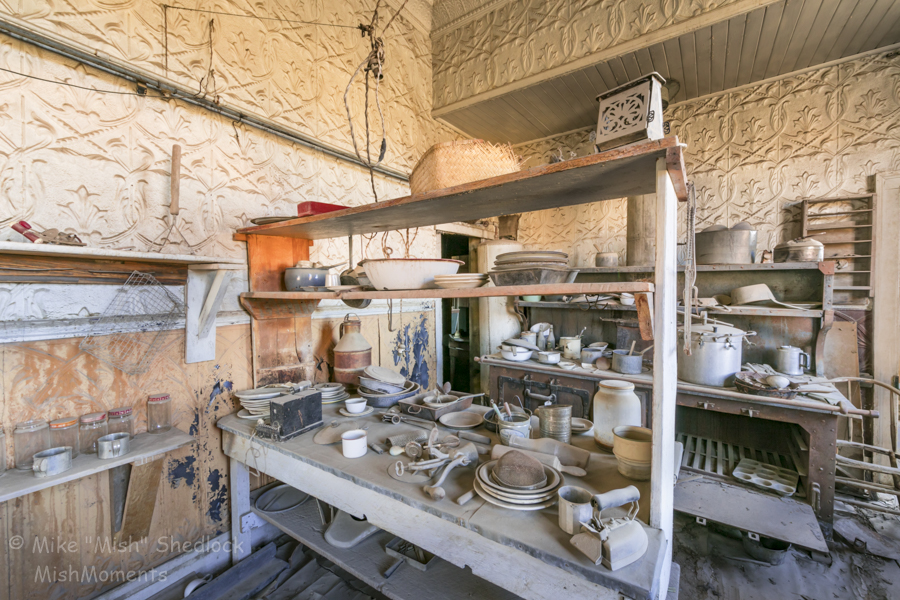
The above three images were taken at 15mm, 14mm, and 11mm respectively. I am just inches away from the scales and other interesting items in the shot immediately above.
Photography Notes
For the interiors, you need wide angle lenses. The wider the better. The above images show why.
If you like this article, please share by email or use one of the share buttons beneath the article.
This is just the beginning of my Bodie series.
There is much more coming up: Sam Leon’s saloon, the morgue, the Methodist church, a Shell gas station, the schoolhouse, the barbershop, other buildings, and milky way shots at night.
Visitors can walk down the deserted streets of a town that once had a population of nearly 10,000 people. The town is named for Waterman S. Body (William Bodey), who had discovered small amounts of gold in hills north of Mono Lake. In 1875, a mine cave-in revealed pay dirt, which led to purchase of the mine by the Standard Company in 1877. People flocked to Bodie and transformed it from a town of a few dozen to a boomtown.
Only a small part of the town survives, preserved in a state of “arrested decay.” Interiors remain as they were left and stocked with goods. Designated as a National Historic Site and a State Historic Park in 1962, the remains of Bodie are being preserved in a state of “arrested decay”. Today this once thriving mining camp is visited by tourists, howling winds and an occasional ghost.
Access
Winter hours 9am to 4pm (November 4th to April 15th)
Summer hours 9am-6pm (April 15th to November 3rd )
In the winter, you may need a snowmobile to get in. The road is not plowed.
The only access at sunrise, sunset, and the interiors of the building is by permit. The cost is steep. My wife Liz and I went on a photography tour at $800 a pop.
The tour gave us access at sunrise, sunset, and the interiors of the building at mid-day.
I was not that interested in instruction. Rather, I paid for access.
These tours are worth it, especially if you need tips and guidance.
The Chemong Mine, founded in 1909, is located near the ghost town of Masonic, CA. It was torn down and rebuilt three times. The structures were eventually abandoned in 1939. By the 1950s the nearby town of Masonic was abandoned also, leaving Chemung to fade quietly into the dust.
If you are visiting the Mono Lake area and the ghost town of Bodie, this ghost town is right in the area and worth a visit. Unlike Bodie, there are no hour restrictions. At your own risk, you can enter the buildings.
Bodie is far better preserved and there are many more buildings. But the hours at Bodie are restricted and you can only enter the buildings on a private tour.
Starburst Tips
To produce a nice starburst effect, position the sun so that it is just peeking out the edge of an object. The light bends around objects as well as the diaphragm blades in the lens.
Tree branches work well and are my typical object. In this case, I use the beam of a ghost town building.
The Canon 11-24 mm lens produces an exceptional starburst. The number of rays is lens-dependent, more specifically, diaphragm dependent. An even number of diaphragm blades in the lens will produce that many rays. An odd number of diaphragm blades will produce double the number of blades.
Both of the above starburst images were taken with my Canon 11-24 mm lens which has 9 diaphragm blades, thus 18 rays in the resultant image, some obscured by clouds.
The Chemong Mine, founded in 1909, is located near the ghost town of Masonic, CA. It was torn down and rebuilt three times. The structures were eventually abandoned in 1939. By the 1950s the nearby town of Masonic was abandoned also, leaving Chemung to fade quietly into the dust.
Feature Image Details
I used Canon EOS 5D Mark IV camera coupled with a Canon 16-35MM F4 L Lens at 16mm. It’s a composite image. The Milky Way was taken separately but this is the correct position of the stars.
I use an iOptron start tracker to take long exposures without the stars blurring. The camera slowly rotates with the stars. I have a second EOS 5D Mark IV Canon body with Canon’s low-pass filter removed, invalidating my warranty, but granting me an extra stop of light. With the iOptron star tracker, I can easily take 2-minute exposures without the stars blurring. The end result is milky way images with far more stars than the naked eye can see.
But if you are tracking the stars, the land is blurry because it isn’t moving. One needs to blend images if using a star tracker.
These images were taken on September 12.
In late August and September, the Milky Way is nearly vertical. The core of the Milky Way is visible only for a short time after sunset this time of year.
In April, the Milky Way takes on a rounded appearance and is visible only very early in the morning (think 3AM or so). In summer the Milky Way is diagonal.
The core of the Milky Way is not visible from October through February.
Additional Chemung Mine Images
If you are visiting the Mono Lake area and the ghost town of Bodie, this ghost town is right in the area and worth a visit. Unlike Bodie, there are no hour restrictions. At your own risk, you can enter the buildings.
Bodie is far better preserved and there are many more buildings. But the hours at Bodie are restricted and you can only enter the buildings on a private tour.
The feature image is a single shot, not a composite or focus stack taken at Ashford Mill, a former mining town settlement in Inyo County, California.
The next image shows what’s left of the mill.
The original mill at the site was built in 1914 by brothers named Ashford. The ore was processed here from the Golden Treasure Mine 5 miles to the east in the Amargosa Range, and processed for further smelting.
Wildflower displays in Death Valley are few and far between. “Super blooms” occur every ten years or so. I was there for the “super bloom” in February of 2016. As “super blooms” go, this one was mediocre. In a true “super bloom” there are huge waves of purple and yellow and more densely packed flowers.
Yet, compared to the typical year, this display was magnificent.
Flowers in Mud Cracks
Harmony Borax Works
The Harmony Borax Works is located in Death Valley at Furnace Creek Springs, then called Greenland.
After the discovery of Borax deposits here by Aaron and Rosie Winters in 1881, business associates William Tell Coleman and Francis Marion Smith subsequently obtained claims to these deposits, opening the way for “large-scale” borax mining in Death Valley. The Harmony operation became famous through the use, from 1883 to 1889, of large Twenty-mule teams and double wagons which hauled borax the long overland route to the closest railroad in Mojave, California.
Darwin Falls
Darwin Falls is located just west of Panamint Springs via a 2.5-mile unpaved road. There is no formal trail. A mostly-level, one-mile walk to the falls involves rock scrambling and several stream crossings. I would rate it as easy.
This small spring provides most of the water for Death Valley.
The above link provides a fascinating story of a town that went from boom to bust in a decade. It had a stock exchange and a red light district that drew people all the way from San Francisco.
In 1906 Countess Morajeski opened the Alaska Glacier Ice Cream Parlor to the delight of the local citizenry. That same year an enterprising miner, Tom T. Kelly, built a Bottle House out of 50,000 beer and liquor bottles.
The Bottle House was restored by Paramount pictures in January 1925.
The ghost town of Rhyolite is on a mixture of federal and private land. It is not within the boundary of Death Valley National Park.
Tom Kelley’s Bottle House
Tom Kelley’s Bottle House Side View
The bottle house is now fenced in with a locked gate. A caretaker unlocked the gate for me one afternoon, but mid-day is not a great time for images. The first image shows the porch in the shade. For the side image of the bottles, I used a polarizer to cut glare from the sun.
Polarizers work best at right angles to the sun, and I am pleased by the overall quality in some brutal light.
Union-Pacific Railroad Car Ruins
Cook Bank
That is what’s left of the once booming Cook Bank.
Notice the straight lines on the sides. Tilting a lens up to fit things in, results in buildings (trees, whatever), that appear to be leaning in.
Sourdough Saloon
Sourdough Saloon is in Beatty Nevada, just minutes from Rhyolite.
If you want to dine in a smoke-filled ash-heap, be my guest. I found the place intolerable. I took one step inside, then left. Nevada has few smoking restrictions and this is typical.
That said, I love the iconic look of the place. Also, I was very fortunate to have a jeep in front instead of a parade of cars.
I took that image shortly after sunset. The ambient light and the lights of the saloon balanced out nicely.
As a general rule, nighttime images like this often look best 15-30 minutes after sunset.
Equipment List
Those interested in my equipment and recommendations can find it here: Mish’s Equipment List.
If you missed them, please check out my previous articles.